
Metabolism: what it is and why it isn't broken

Ian van der Werf
27 September 2026Think years of dieting broke your metabolism? Read what metabolism is, which four parts make up your energy expenditure and how strength training gets it going again.

"My metabolism is broken." Spend enough years dieting and you'll say it sooner or later. You eat very little, the scales barely move, so something must be broken. The feeling is real. The explanation isn't.
Your body is a thrifty system that adapts to what you give it. Once you understand that mechanism, you can see where the controls are. In this blog you'll read what metabolism is, which four parts make up your energy expenditure and why strength training is the lever with the longest-lasting effect.
What is metabolism?
Metabolism is the sum of all the processes your body uses to release and spend energy: breathing, keeping your heart beating, repairing tissue, digesting and moving. In practice, "your metabolism" usually means your total daily energy expenditure, or TDEE. That's the number of calories you burn in a day.
That expenditure is more stable than the stories suggest. A large international study with participants aged 8 days to 95 years showed that energy expenditure, adjusted for fat-free mass, stays remarkably stable between the ages of 20 and 601. The slowdown many people feel around 40 comes mainly from less muscle and less movement. That's exactly why we wrote earlier about strength training after 40.
The four parts of your TDEE
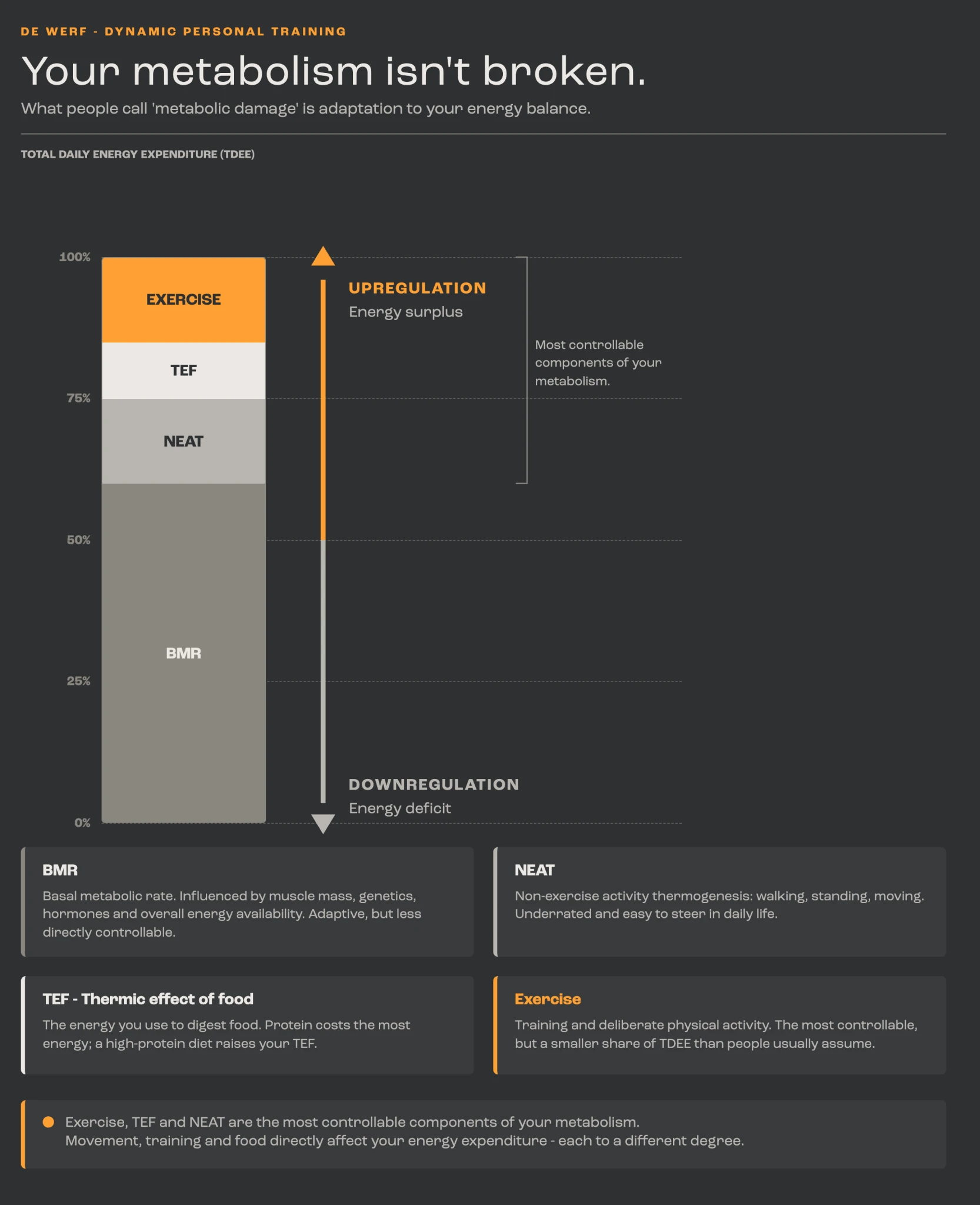
Your daily expenditure is made up of four components:
- BMR (basal metabolic rate): what your body uses at complete rest. At over half to two thirds of the total, this is the biggest part. Muscle mass, genetics, hormones and how much energy you take in set its level.
- NEAT: all movement outside your training. Walking, standing, taking the stairs, cycling to work. Between two people with a similar build, this easily differs by hundreds of calories a day.
- TEF: the energy it takes to digest food, around 10 percent of your total. Protein costs by far the most: roughly a quarter of the calories from protein are spent on digesting it.
- Exercise: your training and deliberate activity. Important, yet a smaller share of the total than most people think.
The top of the bar is the interesting part. NEAT, TEF and training are yours to steer, every single day. You influence your BMR mainly indirectly, through your muscle mass.
Why it isn't broken
What people call "metabolic damage" is adaptation to your energy balance. Eat less than you burn for a longer period and your body shifts down a gear. A lighter body uses less energy. You unconsciously move less: less fidgeting, more lifts, earlier on the sofa. Hunger and fullness hormones shift too. On top of that logical drop, researchers sometimes measure an extra fall in resting expenditure, known as adaptive thermogenesis.
That extra drop exists, and it's smaller than often assumed. A systematic review of 33 studies found that well-designed studies report low or even non-measurable values, and that the effect weakens or disappears after a period of stable weight2. So your system is in energy-saving mode, and that mode is reversible. How to get back to maintenance after a diet is covered in after the diet.
What does linger after years of dieting is muscle loss. Every crash diet without strength training costs muscle, and afterwards it's mostly fat that returns. That's why every new attempt feels harder. How to use a deficit sensibly is covered in the power of a negative energy balance.
Why your TDEE matters
Your energy expenditure decides how much room you have. With a higher expenditure you eat normally, with enough protein and room for a dinner out, and still hold your weight or lose fat. Let your expenditure drop and you have to eat less and less for the same result. Nobody keeps that up for long, and that's exactly where the yo-yo starts.
A high, stable expenditure is really about freedom. That's why, in our nutrition and lifestyle coaching, we first build an eating pattern that matches your expenditure, instead of yet another plan you drop after six weeks.
Strength training as a lever
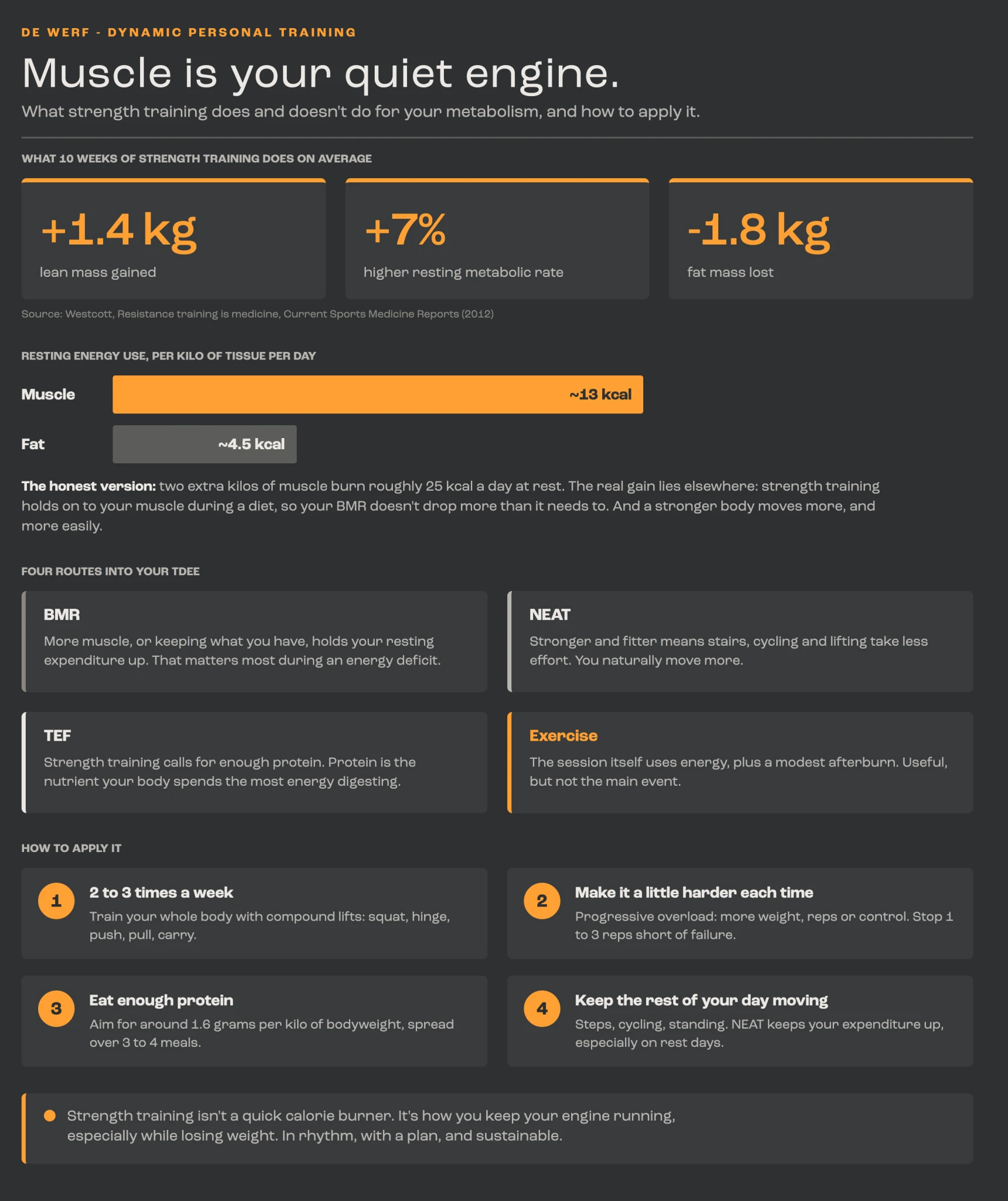
First, the honest version. Muscle uses more energy at rest than fat, roughly 13 versus 4.5 calories per kilo per day. Two extra kilos of muscle therefore gets you about 25 calories a day. It isn't a miracle cure.
The full picture is stronger. Ten weeks of strength training delivers on average 1.4 kilos of lean mass, a 7 percent higher resting metabolic rate and 1.8 kilos less fat3. The biggest gain, though, lies in keeping what you have. Lose weight without strength training and you lose muscle too. A review in Advances in Nutrition concludes that strength training in particular, together with enough protein, protects muscle mass and strength during weight loss4. Less muscle loss means a BMR that drops less and a smaller chance of relapse. How losing fat and building muscle go together is explained in body recomposition.
Strength training touches all four parts of your expenditure. The session itself costs energy. Your muscle mass keeps your BMR up. A stronger body moves more easily, and therefore more. And the protein needs that come with it raise your TEF.
How to apply it
- Train your whole body two to three times a week. Choose compound lifts: squat, hinge, push, pull and carry. The Health Council of the Netherlands recommends muscle and bone-strengthening activities at least twice a week5. New to weights? Start with strength training for beginners.
- Make it a little harder each time. More weight, more reps or more control. Stop one to three reps before you can't do any more.
- Eat enough protein. Aim for around 1.6 grams per kilo of bodyweight, spread over three to four meals. How to get there is covered in how much protein you need.
- Keep the rest of your day moving. Steps, cycling, standing. NEAT keeps your expenditure up, especially on rest days.
- Use a moderate deficit. A small deficit with strength training protects your muscle. A large deficit without it costs you that muscle.
The programme is rarely the problem. Sticking with it is. That's why at de Werf we pair physical training with a rhythm that fits your week, and where needed we work on the habits around it.
A real example from our practice
"She came in with twenty years of dieting behind her and the belief that her body simply wouldn't cooperate any more. We dropped the crash diet, brought her food back up to maintenance, added three strength sessions a week and turned her lunchtime walk into a fixed moment. In the first weeks the scales barely changed, her trousers did. After four months she was stronger than ever, ate more than she had in years and her body fat percentage fell steadily. Her metabolism was never broken. It needed a plan."
Want to know how your expenditure works and how to get it going again? At de Werf in The Hague we coach you one to one with strength training and nutrition, at your own rhythm.
Read also:
Our coaching in physical training and nutrition & lifestyle.
Sources:
1 Pontzer et al. (2021), Daily energy expenditure through the human life course - Science
2 Does adaptive thermogenesis occur after weight loss in adults? A systematic review (2022) - British Journal of Nutrition
3 Westcott (2012), Resistance training is medicine - Current Sports Medicine Reports
4 Cava et al. (2017), Preserving healthy muscle during weight loss - Advances in Nutrition
5 Physical activity guidelines 2017 - Health Council of the Netherlands
Deel deze post


Frequently asked questions about metabolism
Short answers to the questions we hear most about metabolism and strength training.
No. After a long diet you burn less, but that's adaptation, not damage. A lighter body and less unconscious movement explain most of it. The extra drop in resting expenditure is small and fades once your weight has been stable for a while.
About 13 calories at rest, compared with around 4.5 for a kilo of fat. So the direct effect of extra muscle is modest. The real value lies in keeping muscle while losing weight and in a body that moves more, and more easily.
NEAT, TEF and exercise. Together they make up roughly a third to half of your daily expenditure, and you influence them every day through movement, protein and strength training. Your basal metabolic rate you steer mainly indirectly, by keeping and building muscle.
Barely. Adjusted for fat-free mass, your energy expenditure stays remarkably stable between 20 and 60. What does change: many people lose muscle and move less. Strength training and an active daily rhythm largely make up for that.
Ready to get your engine running again?
Schedule a no-obligation intake at de Werf in The Hague. We map your expenditure and build a rhythm of strength training and nutrition that fits your life.
Read more blogs?
A complaint rarely comes from one wrong movement. It appears where everything your body has to proce...


An aquabag, a medicine ball and a resistance band have one thing in common: they do not quite do wha...
