
After the diet: how to eat normally again without relapse

Ian van der Werf
27 September 2026The diet is done, so what now? Read what happens when you start eating more, how to return to maintenance in steps and which habits hold your weight in place.

The last kilo is gone. You fit into those trousers again, you feel lighter and you're done with weighing, counting and saying no. That's exactly when the part that decides whether your result lasts begins.
Almost everyone who loses weight regains some of it later. That rarely comes down to a lack of willpower. It happens because the phase after the diet is hardly ever planned. In this blog you'll read what happens in your body when you start eating more again, how to return to maintenance in steps and which habits hold your weight in place.
Why the phase after matters
Research shows a consistent pattern: first weight loss, then a plateau, then a gradual return of some of the kilos1. After a diet you're often hungrier, you unconsciously move less and old habits creep back. That's biology and behaviour at the same time, and it needs its own approach.
The good news: your body isn't broken. After a diet it's in energy-saving mode, and that mode is reversible. How that works is explained in our blog on your metabolism. Plan the phase after the diet as carefully as the diet itself and you keep far more of your result.
What the scales do first
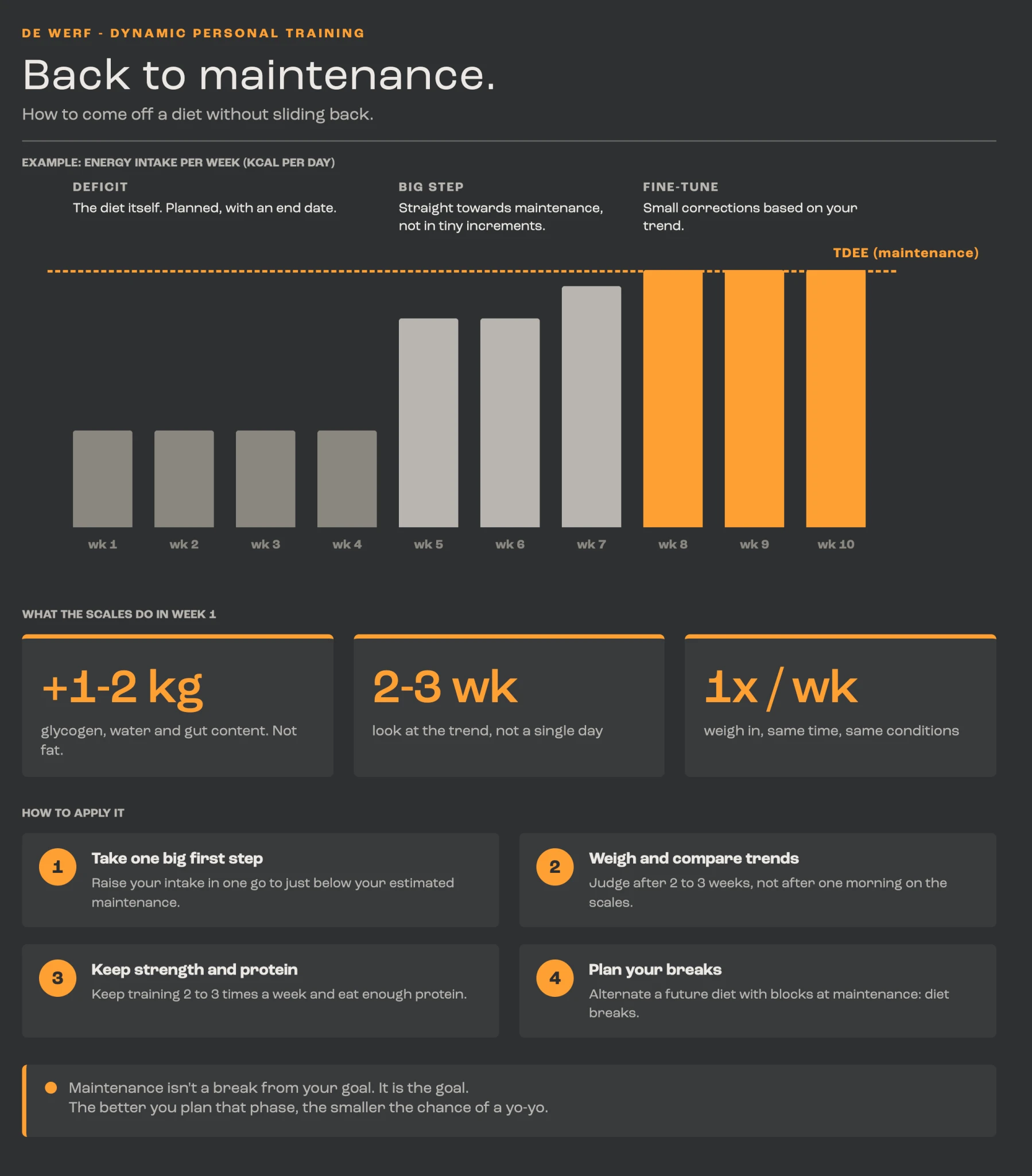
When you start eating more, the scales often show 1 to 2 kilos more in the first week. That isn't fat. Your muscles refill their glycogen stores, glycogen binds water and there's simply more food in your stomach and gut. Building fat takes far more energy than you eat extra in a few days.
That first jump is exactly when many people panic and rush back to dieting. Know it's coming, and only judge after two to three weeks whether your trend is really rising. How misleading the scales can be was described earlier by one of our clients in my fight with the scales.
Back to maintenance in steps
There are roughly two routes back. The first is one big step: you raise your intake in one go to just below your estimated maintenance. The second is reverse dieting, where you add 50 to 100 calories each week. There's little solid research on reverse dieting, and the downside is clear: you stay in a deficit for weeks while your diet is really over.
That's why we usually choose one big first step, followed by fine-tuning. You come out of the deficit quickly, your energy and training improve, and after two to three weeks you adjust based on your weight trend. If it keeps creeping up, you take a little off. If it stays stable, you're at maintenance.
Diet breaks as a strategy
A maintenance phase doesn't only have to come at the end. In the MATADOR study, participants alternated two weeks of deficit with two weeks of eating at maintenance. They lost more fat than the group that dieted for sixteen weeks straight, and their weight stayed stable during the maintenance blocks2.
A planned break isn't failure, it's part of the plan. It gives your body and your head a rest, and you practise the skill you'll need later: staying at your weight. How to use a deficit sensibly is covered in the power of a negative energy balance.
Habits that hold your weight
Roughly one in five people keep off at least 10 percent of their weight for more than a year. What that group has in common: plenty of daily movement, weighing themselves regularly and an eating pattern that looks similar on weekdays and at weekends3. The Netherlands Nutrition Centre advises weighing weekly at a fixed time after losing weight, so you spot an increase early4.
On top of that comes strength training. It protects your muscle mass, and with it your energy expenditure. At de Werf we therefore combine physical training with nutrition coaching. Where needed we also work on the habits around it. The programme is rarely the problem. The rhythm is.
A real example from our practice
"After fourteen weeks of dieting she was eight kilos lighter and terrified of what would come next. Previous attempts had always ended with everything back on. We raised her food by just over 300 calories in one go and agreed she would only look at the trend after three weeks. In the first week the scales showed 1.5 kilos more, and she wanted to quit. By week three that was gone again and her weight stayed stable. Six months later she trains three times a week, eats more freely than ever and still weighs the same."
Want to hold your weight after your diet without starting over? At de Werf in The Hague we coach you one to one with training and nutrition, at your own rhythm.
Read also:
Our coaching in nutrition & lifestyle and behavioural change.
Sources:
1 Hall and Kahan (2018), Maintenance of lost weight and long-term management of obesity - Medical Clinics of North America
2 Byrne et al. (2018), Intermittent energy restriction improves weight loss efficiency in obese men: the MATADOR study - International Journal of Obesity
3 Wing and Phelan (2005), Long-term weight loss maintenance - American Journal of Clinical Nutrition
4 Staying at your weight - Voedingscentrum (in Dutch)
Deel deze post


Frequently asked questions after a diet
Short answers to what we hear most once a diet is over.
Usually 1 to 2 kilos in the first week, and almost none of it is fat. Your muscles refill their glycogen, which binds water, and there's more food in your gut. Only judge after two to three weeks whether your trend is really rising.
A diet break is a planned period, usually two weeks, in which you eat at maintenance in the middle of a weight loss phase. It gives body and mind a rest and lets you practise holding your weight. In research, weight stayed stable during such blocks.
Not necessarily. Reverse dieting, eating a little more each week, has been studied very little and keeps you in a deficit for longer. One big first step towards maintenance, followed by adjusting on your weight trend, is calmer and faster for most people.
Once a week, at a fixed time and under the same conditions, is enough for most people. If you prefer to weigh daily, only look at the weekly average. What counts is the trend over two to three weeks, not a single morning.
Ready to hold on to your result?
Schedule a no-obligation intake at de Werf in The Hague. We plan the phase after your diet, with training and nutrition that fit your life.
Read more blogs?
A complaint rarely comes from one wrong movement. It appears where everything your body has to proce...


An aquabag, a medicine ball and a resistance band have one thing in common: they do not quite do wha...
