
How much protein do you need? How to get enough each day

Ian van der Werf
27 September 2026How much protein do you really need, and how should you spread it across the day? What protein does, why it matters for fat loss and how to get it without fuss.

Protein is the nutrient we get the most questions about in the studio. How much is enough, when should you eat it and do you need shakes? Most people eat less than they think, and almost always too little at breakfast.
That's a shame, because protein works in three places at once: it builds and protects your muscles, it fills you up well and your body spends the most energy digesting it. In this blog you'll read how much protein you need, how to spread it across the day and how to get it without turning your life upside down.
What protein does in your body
Protein supplies amino acids, the building blocks of muscles, tendons, skin, enzymes and hormones. Your body is constantly breaking these down and rebuilding them. When you train, you ask more of that repair, and so you need more protein.
Protein also costs your body the most energy to digest. Of all the nutrients, protein has the largest thermic effect, and it contributes to feeling full1. How that thermic effect (TEF) fits into your total expenditure is explained in our blog on your metabolism.
How much protein per day?
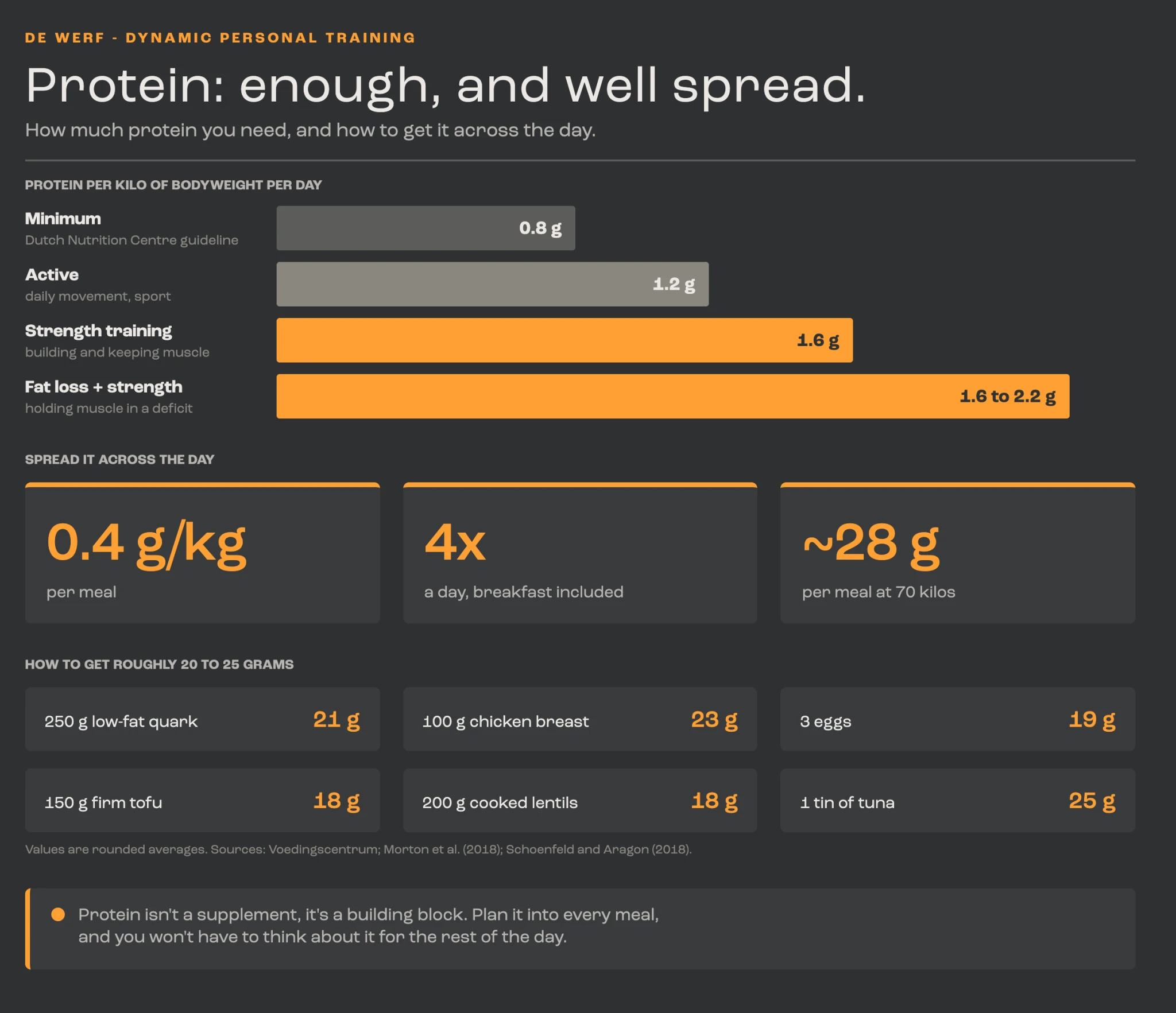
The Netherlands Nutrition Centre uses 0.83 grams of protein per kilo of bodyweight per day for adults2. For someone weighing 70 kilos, that's about 58 grams. See it as the minimum to avoid shortages, not as the target for someone who trains.
If you do strength training, you benefit from more. A large meta-analysis of 49 studies showed that protein increases the muscle gains from strength training, up to a total intake of around 1.6 grams per kilo per day. Above that, on average, nothing more was gained3. For that 70-kilo person, that's around 110 grams a day. According to the Nutrition Centre, up to twice the guideline is considered safe for healthy adults2.
Spread it across the day
How much you eat matters most, but how you spread it matters too. Researchers advise around 0.4 grams of protein per kilo per meal, spread over at least four moments4. At 70 kilos, that's around 28 grams each time.
In practice, the gap is almost always at breakfast and lunch. A slice of toast with jam or a croissant provides hardly any protein, leaving dinner to make up for everything. Move some of it to the morning and the total comes closer by itself.
Protein while losing weight
When you eat less than you burn, protein becomes even more important. Studies with a higher protein intake during an energy deficit show more fat loss, better preservation of muscle mass and a slightly stronger feeling of fullness5. That's why, during fat loss, we aim closer to 1.6 to 2.2 grams per kilo.
Combine it with strength training and you give your body a reason to hold on to muscle. How losing fat and building muscle go together is explained in body recomposition. Once the diet is over, keep your protein intake up while you return to maintenance. How that works is covered in after the diet.
How to get it in practice
- Build every meal around a protein source. Quark, eggs, fish, chicken, tofu, tempeh or pulses. Choose the protein source first, then add vegetables and carbohydrates.
- Start at breakfast. Low-fat quark with fruit or an omelette gets you to 20 to 25 grams in one go.
- Combine plant sources. Plant protein is slightly less complete and less digestible. According to the Nutrition Centre, vegans need around 30 percent more2.
- See a shake as a tool. Handy after training or on the go, but ordinary food does the same job.
- Give it extra attention as you get older. The effect of protein on muscle building declines with age3, and that's exactly when holding on to muscle matters. We wrote about that earlier in strength training after 40.
At de Werf, our nutrition and lifestyle coaching looks at what you eat now and where the gap is. In your training sessions we make sure that protein is actually put to use.
A real example from our practice
"He was 63, trained twice a week and noticed he was getting weaker rather than stronger. His day started with two crispbreads, lunch was a cheese sandwich and only at dinner did real protein reach the table. Altogether he got around 60 grams a day. We added quark to his breakfast, turned lunch into a salad with eggs or fish and kept dinner as it was. Three months later he was at over 110 grams, his weights on the squat and the row had gone up considerably and he no longer needed a rest halfway up the stairs to his study."
Want to know whether you eat enough protein, and how to fit it into your week? At de Werf in The Hague we coach you one to one with training and nutrition, at your own rhythm.
Read also:
Our coaching in nutrition & lifestyle and physical training.
Sources:
1 Westerterp (2004), Diet induced thermogenesis - Nutrition and Metabolism
2 Protein - Voedingscentrum (in Dutch)
3 Morton et al. (2018), A systematic review, meta-analysis and meta-regression of the effect of protein supplementation on resistance training-induced gains in muscle mass and strength in healthy adults - British Journal of Sports Medicine
4 Schoenfeld and Aragon (2018), How much protein can the body use in a single meal for muscle-building? - Journal of the International Society of Sports Nutrition
5 Leidy et al. (2015), The role of protein in weight loss and maintenance - American Journal of Clinical Nutrition
Deel deze post


Frequently asked questions about protein
Short answers to the questions we get most about protein.
Not in healthy adults. The Netherlands Nutrition Centre sees no clear evidence that a high protein intake is harmful, and up to twice the guideline is considered safe. If you have a kidney condition, talk to your GP or specialist about your protein intake first.
Yes, although you need a little more. Plant protein is less digestible and less complete, so the Nutrition Centre calculates with around 30 percent more for vegans. Combine pulses with grains, soya and nuts, spread across the day.
No. A shake is handy after training or when you're on the go, but ordinary food provides the same protein. If you easily reach your target with quark, eggs, fish, meat or pulses, a shake adds little besides convenience.
Your body absorbs almost all protein, even large portions. For building muscle, around 0.4 grams per kilo per meal spread over four moments seems most effective. For someone weighing 70 kilos, that's around 28 grams per meal.
Want to know if you eat enough protein?
Schedule a no-obligation intake at de Werf in The Hague. We look at what you eat now and build a plan that fits your training and your week.
Read more blogs?
A complaint rarely comes from one wrong movement. It appears where everything your body has to proce...


An aquabag, a medicine ball and a resistance band have one thing in common: they do not quite do wha...
