
Biotensegrity: why your body is a network

Ian van der Werf
31 August 2026Your body holds itself up with tension: bones float in a web of muscle, tendon and fascia. What biotensegrity means for your training, your recovery and your vitality.

Your body does not hold itself up the way a brick wall does. It stands under tension, like a tent whose guy ropes are all pulled tight. Pull on one rope and the whole canvas changes shape. That is the heart of biotensegrity, and it explains why a stiff hip announces itself as pain between your shoulder blades.
The term comes from architecture. There are structures in which rigid struts never touch each other; they float in a web of cables held under tension. The American orthopaedic surgeon Stephen Levin recognised that pattern in the human body and named it biotensegrity: a living structure that owes its shape to tension.
What biotensegrity actually says
In this model your bones handle the compression while muscles, tendons, ligaments and fascia handle the pull. The skeleton floats in a web of tissue that sits under light tension everywhere. Take that web away and no standing frame remains, just a heap of loose bones on the floor.
That build has a practical consequence: load spreads. A structure under tension absorbs an impact with the whole network rather than with a single point. It is why you can land from a jump without your ankle processing your entire body weight, and why the force of a deadlift travels from your feet into your upper back.
The principle does not stop at the skeleton. Researchers at Harvard's Wyss Institute showed that even single cells organise themselves along this same tension principle and change shape as soon as they are pulled on1. From cell to whole body, the same building logic applies.
Why the pain rarely sits where it started
If everything connects to everything, load travels. That is exactly what fascia research shows: force is transmitted between muscle groups within one leg, and even from the leg into the trunk2. How much force passes across, and under which conditions, is still debated. That transmission happens at all is settled.
For you that means something very practical. The spot that hurts is the end of a chain. A shoulder that keeps flaring up sometimes traces back to a thoracic spine that barely rotates any more. A stubborn hamstring often hangs on a pelvis that is loaded unevenly. That is why injury recovery at de Werf starts with the question of where the load comes from, before we do anything to the spot that shouts loudest.
What this means for your training
A body that works as a network is trained as a network. Isolating a muscle has its place, certainly for tissue that has to learn to carry again after an injury. Most of your programme consists of movements in which several joints work together: pushing, pulling, hinging, carrying and rotating.
It also explains why training on a wobbly surface delivers less than it appears to. Your network mainly learns to stand still on a moving floor. We wrote about that earlier in why you don't train stability on a bosu ball. Solidity comes from a network that can build tension under real load and release it again.
One more consequence: a programme that looks right on paper can still grate on you, because your network is strung differently from your neighbour's. That difference is the subject of standard training doesn't work for your body.
How we work with this at de Werf
Every programme starts with a movement analysis. We look at how your trunk turns with a step, what your hip does in a squat, where the range stops when you reach. In physical training we build a programme from there that loads the weak link and unloads the overworked one.
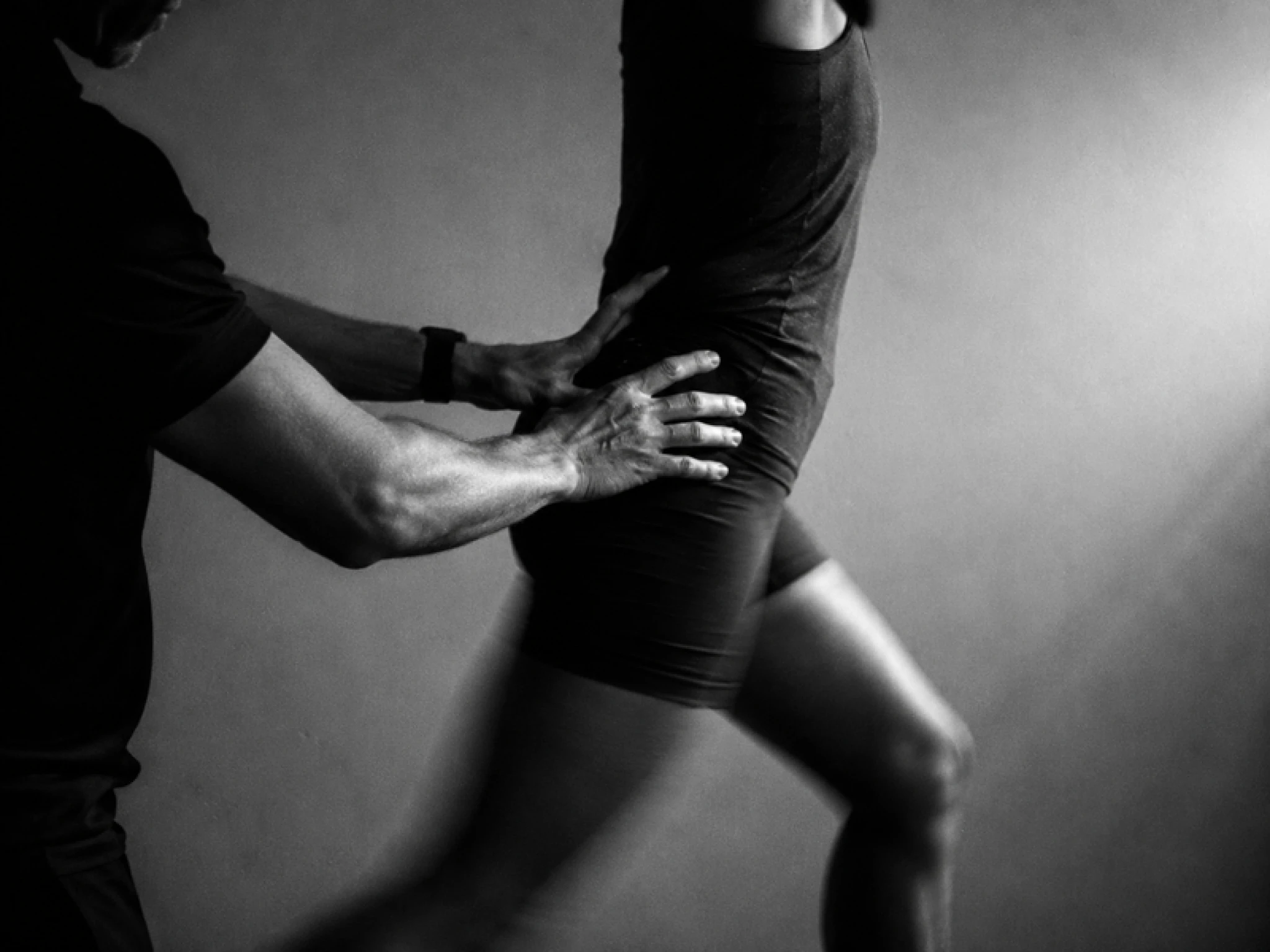
If an area stays stuck, we escalate. With manual therapy we create room in a segment that is blocking the rest of the chain, after which training holds that room open. Treatment and training run through each other at de Werf, precisely because your network takes no notice of the divide between treatment room and gym floor.
A real example from our practice
I came in with a neck that had been nagging for two years. The first session was about my ankle. I understood none of it, until I saw on video that I skipped over my right hip with every step and my shoulder was absorbing it. We worked on my lower body for three months. The neck has gone quiet without us ever touching it directly.
What this has to do with your vitality
Tissue adapts to what you ask of it. Move in varied ways and the network stays elastic and spreads load across many links. Sit for six hours a day at the same angle and the tissue settles into that one position: shorter at the front, slack at the back, and less able to absorb a sudden load.
Vitality is the reserve you have left at the end of your day. A network that distributes tension well costs less energy in everything you do: climbing stairs, lifting, sitting upright through a meeting. When one place seizes up, the rest works overtime. You notice that as tiredness sooner than as pain.
The Dutch Health Council advises adults to do at least two and a half hours of moderately intensive activity a week, supported by muscle and bone strengthening work, and to break up long stretches of sitting3. That last part matters to your connective tissue as much as the training itself. Tension works both ways here: stress puts your tissue on edge, and stuck tissue holds stress in place. That is what we work on in our coaching for burnout and stress.
Want to know how your network is strung?
Book a no-obligation intake at de Werf in The Hague. We map out how you move, where load gets stuck and which link asks for attention first.
Read also:
Our coaching in physical training and injury recovery.
Sources:
1 Wyss Institute, Harvard - The 'architecture of life' described by computer modeling
2 Journal of Applied Physiology - Not merely a protective packing organ? A review of fascia and its force transmission capacity
3 Gezondheidsraad - Beweegrichtlijnen 2017, the Dutch physical activity guidelines
Deel deze post


Frequently asked questions about biotensegrity
Biotensegrity means your body owes its shape to tension. Your bones take the compression, while muscles, tendons, ligaments and fascia hold the whole thing under pull. Load therefore spreads across the entire network instead of resting on a single point.
Because force travels through the network. Research shows tension is transmitted between muscle groups and even from leg to trunk. A stiff hip makes your shoulder work harder, and the complaint surfaces at the spot that stops coping with the compensation first.
No. Targeted exercises are useful for building up a weak link or getting tissue to carry load again after an injury. Most of your programme is made up of movements in which several joints work together, because that is how daily life loads you too.
A network that distributes tension well costs less energy. When load gets stuck in one place, the rest of your body works overtime and you have less left at the end of the day. You usually notice that as tiredness before you notice it as pain.
Your programme starts with a movement analysis of the whole chain, including areas that give you no trouble. From there you train in compound movements, and we bring in manual therapy as soon as one segment keeps blocking the rest of the chain.
Want to know how your network is strung?
Book a no-obligation intake at de Werf in The Hague. We map out how you move, where load gets stuck and which link asks for attention first.
Read more blogs?
A complaint rarely comes from one wrong movement. It appears where everything your body has to proce...


An aquabag, a medicine ball and a resistance band have one thing in common: they do not quite do wha...
