
Perturbation in your training: learning to react to the unexpected

Ian van der Werf
29 September 2026An aquabag, a medicine ball and a resistance band have one thing in common: they do not quite do what you expect. That is exactly why they work. It trains your ability to correct before you think about it.

You step off the kerb, the paving stone sits at an angle, and within a tenth of a second your hip has already corrected. You decided none of that. That is your nervous system absorbing a disturbance, faster than your conscious brain can register it.
In the gym that system rarely gets any work. A barbell weighs exactly the same on rep ten as it did on rep one, and a machine fixes your movement path before you start. Perturbation training puts the unpredictability back into the exercise, in a dose you control, so your capacity to correct grows alongside the strength you are building.
What a disturbance does to your nervous system
A perturbation is an external disturbance that pushes you off your line and forces you to correct. The principle has been studied most thoroughly in balance training: participants absorb repeated, controlled pushes in a safe set-up. The body adapts to that quickly, and after one solid session the adaptation is still measurable up to a year later.1
That finding comes with a caveat. The adaptation is specific to what you practise. Someone who learns to absorb a push from the front cannot automatically do the same sideways. The disturbance has to come from varying angles, otherwise your body learns a trick instead of a skill.
Why this matters shows in the Dutch figures: VeiligheidNL counts roughly a million people over 65 falling every year, with one of them arriving at accident and emergency every four minutes.2 Those numbers describe older adults, while the corrective capacity behind them erodes gradually. Maintaining it starts decades earlier, and belongs in the same programme in which you keep building strength after 40.
The aquabag: water that lags behind your movement
An aquabag is a bag you fill partly with water. Lift it and the water follows your movement a fraction late. Rack it on your shoulders for a front squat and the centre of gravity shifts during the descent, exactly when your trunk already has something else to do. In a lunge or a twenty metre carry the same thing happens sideways: every step comes with a correction you did not plan.
The dose sits in the water level. A nearly full bag still behaves much like a barbell. Half full it turns restless, and that is where the work starts. Why an unstable surface does not produce this effect, we wrote earlier in why you don't train stability on a Bosu ball.
The ball: a disturbance you do not control
With an aquabag you still cause the disturbance yourself. A ball takes that control away. Throw a medicine ball against the wall and it returns at a slightly different angle. Catch it on one leg and your ankle, knee and hip make their judgement in the same movement. With a trainer working alongside you, the timing can be broken on purpose: a throw half a beat early, a pass just outside your reach.
That is the closest translation of how it goes outside. A dog pulling on the lead, a child suddenly letting itself hang, a wet paving stone tilting. None of them waits until you are ready.
The band: a pull from the wrong direction
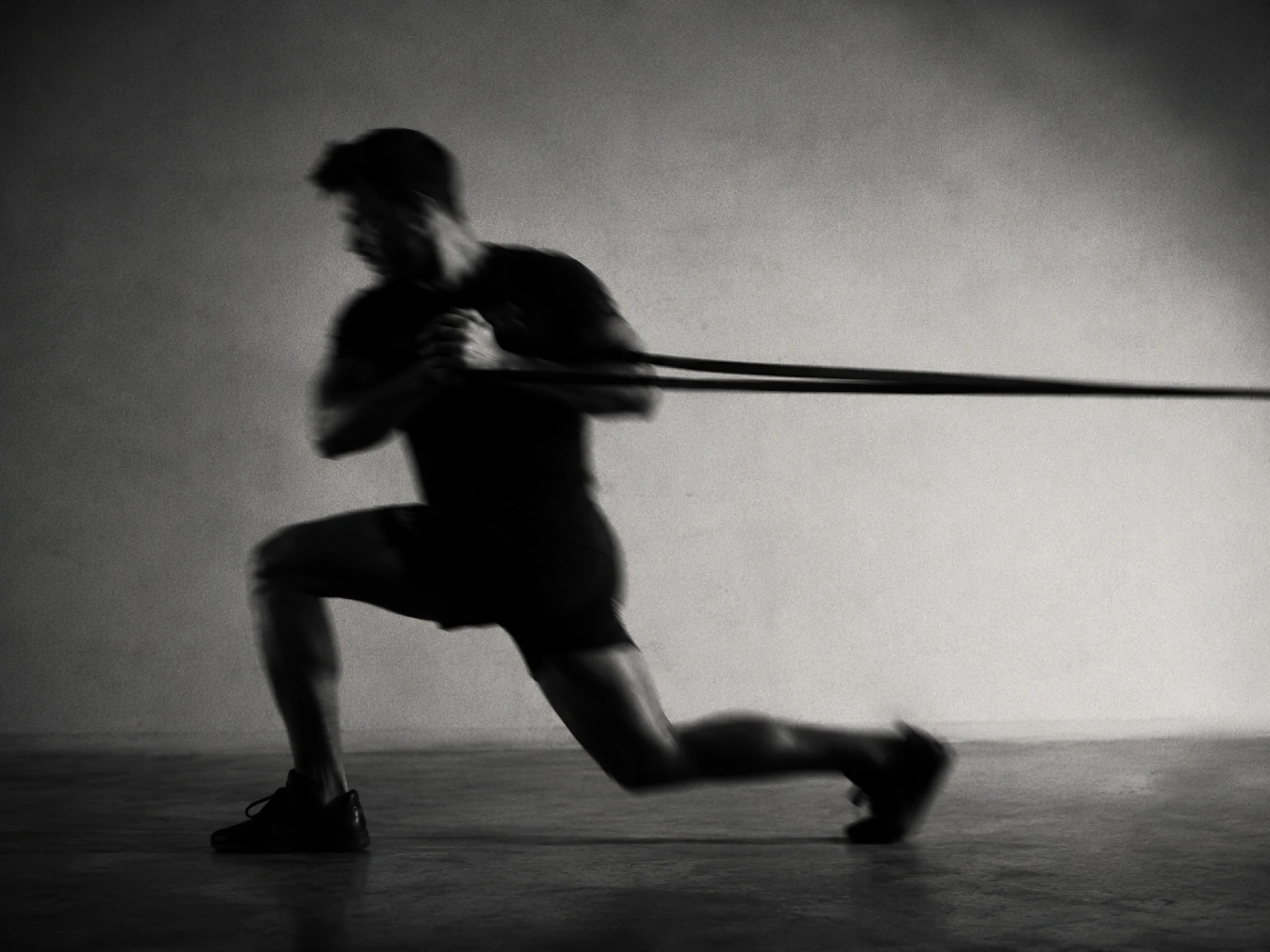
A resistance band does something a weight cannot: it pulls sideways. Anchor it at hip height, stand at a right angle to it and perform a split squat, and your hip and trunk hold off a lateral pull for the whole set. Move the anchor a quarter turn and the same exercise asks something entirely different of you.
The sharpest stimulus comes from the trainer. A short tug on the band during the upward phase, at a moment you cannot see coming, forces a correction without any need to add weight. That makes it useful in injury recovery, where you want to challenge reaction capacity while joint loading stays low. If a medical complaint is still running underneath, we coordinate it with the physiotherapist.
How much disturbance does your training need?
Perturbation work is neurological work and returns little with a tired system. So it sits at the front of the session, after the warm-up and before the heavy lifting. Two to four exercises, sets of six to eight repetitions per side or twenty to forty seconds, twice a week: that is enough to get the effect.
Vary the direction of the disturbance, because the adaptation follows precisely what you practise.1 And keep the base intact. Strength stays the foundation; perturbation is the finishing work that makes that strength available at the moment you had not planned for it. In our physical training the two sit side by side in the same block.
How we build it up at de Werf
The pattern under ordinary load comes first. Only once a split squat looks calm under a barbell does the aquabag go on. Then the band. And only then does something arrive that you do not control. Reverse that order and you mostly practise compensating, a habit you have to unlearn later.
A real example from our practice
A client in his sixties came in because he had nearly gone down on the quay with a mooring line in his hands. He had been strength training for years, neatly and heavily. What he had never practised was correcting with something in his arms that moves by itself. We started with carries using a half-filled aquabag over twenty metres, later with a band I would tug once along the way. After three months he told me he dared to turn on deck again without first checking where he was putting his foot.
Want to learn to react to the unexpected?
Schedule a no-obligation intake at de Werf in The Hague. We look at how solid your base is and where disturbance adds something, and place it in your programme where it works.
Read also:
Our coaching in physical training and injury recovery.
Sources:
1 Frontiers in Sports and Active Living - Perturbation-based balance training
2 VeiligheidNL - Infographic on falls among over-65s
Deel deze post


Frequently asked questions about perturbation
Twice a week is enough. Place two to four exercises with disturbance at the front of the session, right after the warm-up, and keep the sets short: six to eight repetitions per side or twenty to forty seconds. A tired nervous system returns little.
Yes, provided the base movement is pain-free and the dose starts low. After an injury a resistance band is particularly useful: it challenges your reaction capacity while joint loading stays low. If a medical complaint is still running, we coordinate it with your physiotherapist.
Partly. A band anchored sideways already gives a real stimulus at home during split squats and presses. What you miss at home is the unpredictable element: someone tugging the band at a random moment. Ask a housemate to take on that role.
You need a calm base pattern, not impressive numbers. If a split squat or a carry looks stable under ordinary load, that is your cue. Start earlier and you mainly practise compensating, and that habit has to come out again later.
Want to learn to react to the unexpected?
Schedule a no-obligation intake at de Werf in The Hague. We look at how solid your base is and where disturbance adds something, and place it in your programme where it works.
Read more blogs?
A complaint rarely comes from one wrong movement. It appears where everything your body has to proce...


How much protein do you really need, and how should you spread it across the day? What protein does,...
