
Don't wait for January: start your resolution now

Ian van der Werf
02 November 2026From 2 November to 1 January is sixty days, roughly the time a new habit needs. Why starting now beats starting on New Year's Day.

By early November, plenty of good intentions are already lined up in people's heads. Move more, get stronger, lose a few kilos. Only the start date is fixed: 1 January. Until then the plan waits, and that waiting costs more than you might think.
Take a look at the calendar. From 2 November to 1 January is exactly sixty days. Start today and you will have two months of rhythm behind you by New Year's Day. Wait, and you are back at zero, right in the busiest gym weeks of the year.
Why January is a tricky start
A new year feels like a clean slate, and that feeling really does help you get moving. The catch is that you want everything at once: training every day, eating differently, going to bed earlier. After a few weeks ordinary life returns, and a plan that runs on motivation rarely survives that.
A large Swedish study of more than a thousand resolutions found that after one year, 55% of participants felt they had succeeded1. That is less bleak than the idea that 'everyone gives up in February', but it still means almost half do not make it. The difference lay mainly in how the goal was written down. More on that shortly.
The holidays count too
The stretch between mid-November and January has a reputation of its own. Part of it is exaggerated. In an American study of 195 adults, participants gained around 0.37 kilos on average over those weeks2. Not much, you might say. The sting was that those kilos did not come off after the holidays, and that the festive period explained roughly half of the total weight gained over the year.
That is exactly why waiting until January is awkward. You walk into the new year slightly behind, and then start a plan that first has to make up that ground. If you already have a fixed training slot now, you sit down to dinner in December differently. Not because you deny yourself anything, but because your body and mind have a rhythm that a Christmas meal simply fits into.
A habit needs time
How long does it take before something happens on autopilot? Researchers at University College London followed participants as they built a new daily habit. On average it took 66 days before the habit felt automatic, with big differences: from 18 days to an estimated 250 plus3. Skipping a single day made little difference. Skipping again and again did.
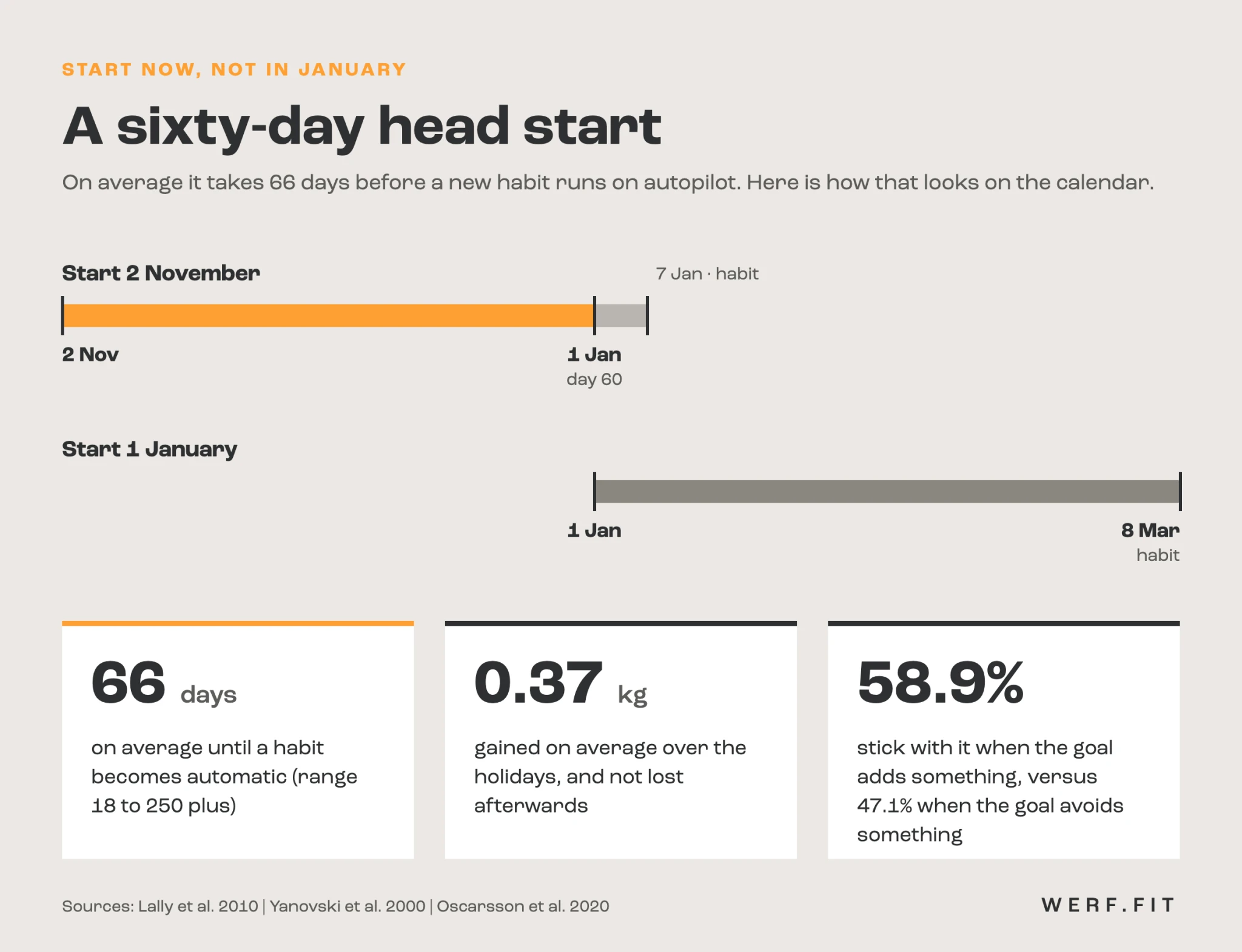
Put that next to the calendar and the picture is clear. Start now and you will be around day sixty on 1 January, close to the point where training no longer takes willpower. Start on 1 January and you hit the hardest part during the months when it is dark and work picks up again. If that hurdle sounds familiar, have a look at our piece on having no motivation to train.
Write down what you will do
The Swedish study showed something else too. People with a goal that adds something, such as 'I will do strength training twice a week', stuck with it more often (58.9%) than people with a goal that avoids something, such as 'I will stop eating sweets' (47.1%)1. An avoidance goal gives you no action. You know what not to do, but not what you will do on Tuesday evening at seven.
So make it concrete and small enough to fit into your week:
- What will you do? For example, two one-hour training sessions a week.
- When? A fixed day and time, as fixed as a work meeting.
- What will you do when it goes wrong? You do not make up a missed session with a double one. You simply pick up the next appointment.
At de Werf we call that rhythm. It is part of how we approach behavioural change: first a pattern you can keep up, and only then do we raise the intensity.
How to use the next eight weeks
You do not need to reach peak shape in November. The point of these weeks is a foundation, so January becomes a continuation and not a fresh start.
- Weeks 1 and 2: measure and plan. Find out where you stand. With us that starts with an intake and a baseline measurement, so in January you can see what has changed instead of guessing.
- Weeks 3 to 5: fixed moments. Two training sessions a week that go ahead, even in busy weeks. New to weights? Start with the basics from strength training for beginners.
- Weeks 6 to 8: the holidays. Keep the appointments in place and adjust where needed. One session fewer is fine; zero sessions is the start of starting over.
Nutrition simply comes along with it. You do not need to diet in December. It does help to have a few fixed anchors, such as enough protein and regular meals. If you would like support with that, nutrition and lifestyle fits alongside physical training.
A real example from our practice
"Alex, in his late thirties, came in last year in mid-November. The plan was to 'start properly in January', but he wanted to know where he stood first. We agreed on two fixed evenings and kept to those two in December, even in the week of the office parties. On 2 January he was simply back in the studio, while the place filled up with new faces around him. In his words: 'I didn't have to start. I just carried on.'"
Start this week
You do not have to wait for a new year to start a new habit. Book a no-obligation intake and together we will work out where you stand and what your next eight weeks look like.
Read also:
Our coaching in behavioural change and physical training.
Sources:
1 Oscarsson et al. (2020), A large-scale experiment on New Year's resolutions, PLOS ONE
2 Yanovski et al. (2000), A prospective study of holiday weight gain, NEJM
3 Lally et al. (2010), How are habits formed, European Journal of Social Psychology
Deel deze post


Frequently asked questions about starting now
Short answers to the questions we hear most often in November.
No, rather the opposite. Start now and you will already have a steady rhythm when the festive weeks arrive. A session in December then takes less effort, and the kilos that often stick around after that period stay limited. Start in January and you begin slightly behind.
Around 0.37 kilos on average, according to a study of 195 adults. That sounds like little, but those kilos did not come off afterwards. The festive period explained roughly half of what participants gained over a whole year.
Write down what you will do instead of what you want to stop. Goals that add something were kept more often (58.9%) than goals that avoid something (47.1%). Make it concrete, with a fixed day, a fixed time and a plan for when you miss a session.
That is fine, as long as you simply pick up the next appointment. In research on habit formation, missing a single day made little difference. Only when missing becomes a pattern does the habit fade. So there is no need to make up for it with double sessions.
Start now, not in January
In a no-obligation intake we work out together where you stand and what your next eight weeks look like.
Read more blogs?
December is the month of drinks. What alcohol does to your muscle recovery and sleep, and how to com...


Shorter days, less light and a full diary. Why your energy drops in winter and how daylight and fixe...
