
Runner's heel: tackling heel pain from running

Ian van der Werf
20 August 2026That first step out of bed shoots through your heel. What runner's heel is, how to spot it, who gets it and why rest alone is rarely enough.

You get out of bed in the morning and that first step shoots straight through your heel. Ten minutes later it fades, so you lace up and go for your run anyway. Two weeks on it hurts while you run as well, and it is still there on the sofa that evening.
That pattern has a name: plantar fasciopathy, known among runners as runner's heel. It accounts for roughly ten per cent of all running injuries.1 And it rarely disappears if you ignore it.
What is runner's heel exactly?
A broad, stiff band of tissue runs under your foot from your heel bone to your toes: the plantar fascia. It tightens the moment you push off and gives your foot its spring. Ask more of it than it can handle, week after week, and small damage builds up where it attaches to the heel bone. That is where the pain sits.2
The word heel spur usually comes up in the same conversation. That little calcium point on an X-ray is the result of years of pulling force. Plenty of people with a spur have no symptoms at all, and plenty of people with severe heel pain have no spur.
How to recognise it
Four features together make the picture almost complete:2
- The first steps after getting up, or after sitting for a long time, hurt most. Then it settles.
- It warms up while you move and feels better. Afterwards and in the evening it returns.
- There is one clear tender spot on the inside of your heel, where the fascia attaches.
- Walking barefoot on a hard floor or standing still for long periods makes it worse.
Start-up pain that eases off and comes back later is the giveaway. Swelling, bruising or pain that wakes you at night does not belong to this picture.
Not all heel pain comes from the fascia
Heel pain is a symptom, not a diagnosis. If the pain sits at the back of your heel rather than underneath it, the Achilles tendon or an inflamed bursa is the more likely source.3 A dull, spread-out feeling in the middle of the heel after a hard landing points more often to the fat pad. Tingling or numbness radiating into the sole belongs to a trapped nerve.
Two signals call for prompt medical assessment. Pain that keeps increasing and persists at rest can indicate a stress fracture of the heel bone. And a sudden snap at the back, after which you cannot push off, is a reason to seek help the same day.3
Where does it come from?
In almost every case, load rises faster than the tissue can adapt. The factors that speed that up are well documented:2
- A quick jump in distance, pace or elevation
- Stiff calves and a short Achilles tendon
- Limited movement in the ankle
- A high arch, or a collapsed one
- New shoes, or months of running on worn-out soles
- Long hours standing or walking on hard floors
- A higher body weight
- Long sedentary days followed by a peak at the weekend
So it is rarely about one faulty foot. It is about the gap between what you ask of your foot and what you have built up.
Who gets it?
Around one in ten people will deal with it at some point, peaking between the ages of forty and sixty.1 More than eighty per cent of everyone with the complaint is a working adult aged 25 to 65. Runners make up part of that group, not the bulk of it.
We see it in the hairdresser who stands for six hours a day, in the nurse after a run of night shifts, in someone who takes up walking with enthusiasm after years of sitting still. Running brings the problem to light faster, because every step sends two to three times your body weight through that band of tissue. In most cases the groundwork was already there before you started running.
Rest, or keep moving?
Rest takes the pain away for a while. The problem is what you get back when you start again: a fascia and a calf that have grown weaker in the meantime and can handle less than before the injury. Six weeks of doing nothing almost always ends in a setback during the first serious session.
What does work is lowering the load temporarily while building strength in a targeted way.2 In practice:
- Reduce your running volume instead of dropping it to zero. Softer surfaces, shorter distances, easier pace.
- Add cycling or swimming so your fitness holds up.
- Do not walk barefoot on tiles or laminate indoors.
- Use pain as your measure. Up to about three or four out of ten while running is acceptable, as long as the next morning is no worse than the last.
That morning check tells you more than what you feel during the run. Your heel only reveals the following day whether the dose was right.
Heavy loading beats stretching alone
Stretching is the standard advice you find everywhere. It helps, though it is not the strongest tool you have. Researchers compared stretching with heavy strength training for the foot in 48 people with this complaint. After three months the strength group scored 29 points better on the Foot Function Index. After a year both groups had recovered to a similar level.4
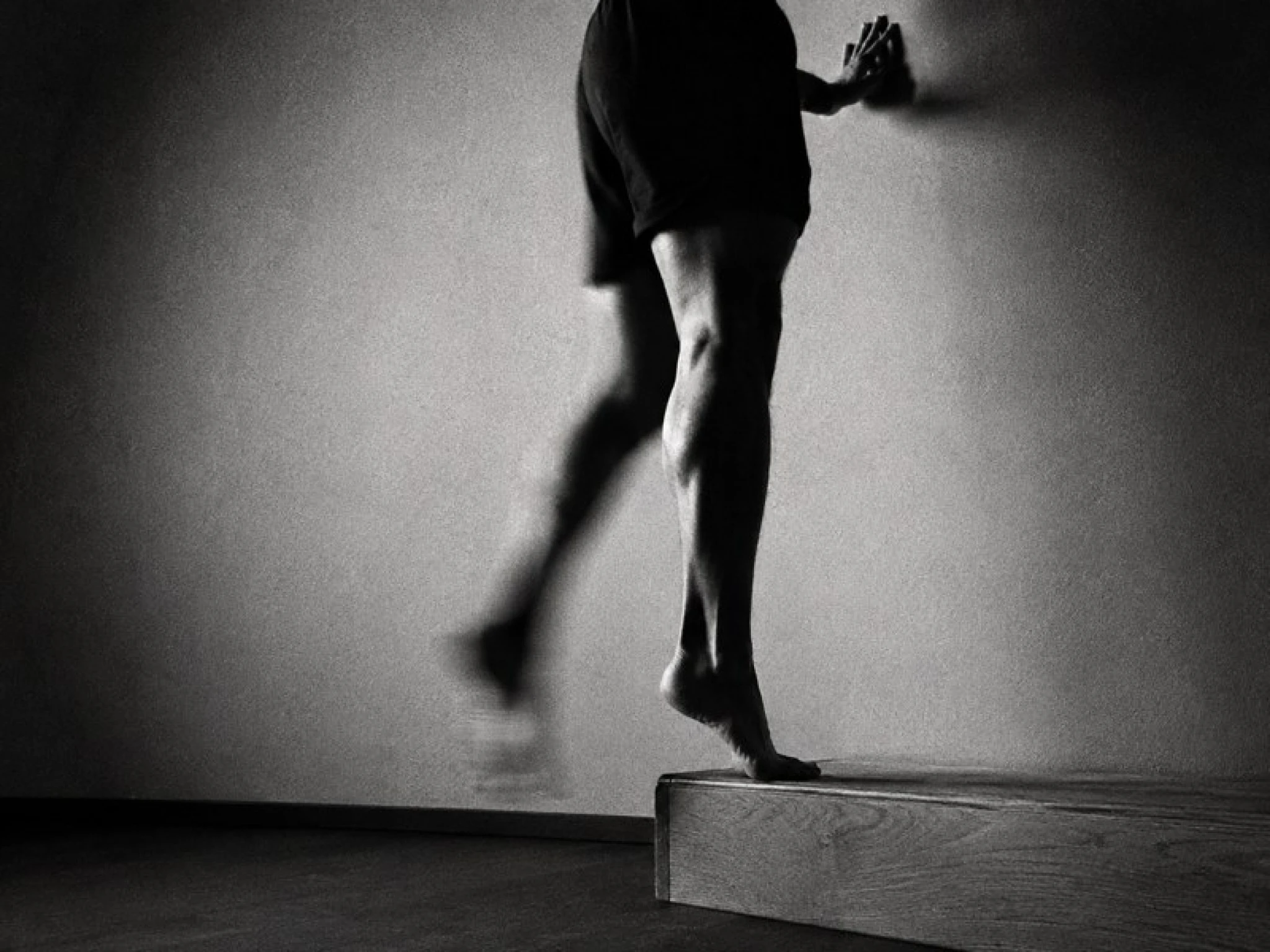
The exercise itself: a single-leg heel raise with a rolled towel under your toes. Three seconds up, two seconds held, three seconds down. Every other day, twelve weeks long, with steadily more weight in a rucksack. From three sets of twelve to five sets of eight.4
What you gain from that is mainly time. Around three quarters of people recover within a year without targeted training too.1 A year is simply a long stretch when you want to run now.
A real example from our practice
I ran three times a week and assumed the heel was part of the deal. Physio helped, but the moment I picked up my old programme it was back within a fortnight. At De Werf they looked beyond my foot. My calves were stiff, my hip barely contributed to the push-off, and after every break I built back up far too quickly. We started with strength and a build-up that moved week by week with whatever my heel told me the next morning. Four months later I ran my first ten kilometres without giving it a thought.
What personal training adds
Finding an exercise is not the hard part. Keeping it at the right load for four months while your life carries on is. That is where the gain sits.
In our injury recovery coaching we look at the whole chain. Ankle mobility, calf strength, how your hip contributes to the push-off, how much you stand and sit in a day. We adjust the dose each week based on your pain response, rather than printing a twelve-week programme and hoping it fits. Your return to running is staged, with strength as the base in physical training.
If the complaint proves stubborn or something medical is at play, we refer internally to physiotherapy or manual therapy. If weight is a factor, we address it through nutrition and lifestyle. We wrote earlier about the handover from treatment to building up in why De Werf follows on from physiotherapy.
Why De Werf is the place to recover
Physiotherapy and personal training sit under one roof here. That closes the gap that often opens after a course of treatment: you are out of pain, you are cleared, and nobody tells you how to get from zero to thirty kilometres a week without ending up back at the start.
Ian van der Werf works along one line. First reflection on what your body and your week can genuinely handle, then rhythm in the build-up, then results. The plan moves with whatever your week throws at it. You can read how that works out for other injuries in how movement helps injury recovery.
When should you get help?
Have your heel looked at if the pain has not eased after two weeks of adjusting, if you develop tingling or numbness, if the pain persists at rest, or if you can no longer push off normally.3 If you have diabetes, get help sooner. Waiting almost always makes the process longer.
Stuck with a painful heel?
Schedule an intake with Ian van der Werf at De Werf in The Hague, with no obligation. We look at your heel, your build-up and your week, and decide together what makes sense now.
Read also:
Our coaching in injury recovery and physical training.
Sources:
1 StatPearls (NCBI) - Plantar fasciitis
2 Thuisarts.nl - Pain under my foot (heel spur)
3 NHS - Heel pain
4 Rathleff et al. - High-load strength training for plantar fasciitis
Deel deze post


Frequently asked questions about heel pain from running
The questions we hear most often from runners with a painful heel.
Expect months rather than weeks. Around three quarters of people are symptom-free within a year. With targeted strength training you are usually noticeably further along within three months, though the twelve-month outcome is similar either way.
Yes, as long as you adjust the dose. Pain up to about three or four out of ten while running is acceptable, provided your heel feels no worse the next morning. If the start-up pain increases, the previous session was too much.
They relieve, they do not cure. An insole or cushioned shoe temporarily takes pulling force off the fascia and makes walking bearable. Your foot's capacity does not change because of it. Use them as support alongside your strength work.
No. A heel spur is a calcium outgrowth on the heel bone that shows up on an X-ray. Runner's heel is the painful overloading of the fascia underneath it. Many people with a spur have no symptoms, and many people with heel pain have no spur.
Because your foot rests in a slightly pointed position for hours overnight and the young repair tissue sticks together. The first steps stretch all of that at once. After ten minutes or so the fascia has warmed up and the pain eases.
Stuck with a painful heel?
Schedule an intake with Ian van der Werf at De Werf in The Hague, with no obligation. We look at your heel, your build-up and your week, and decide together what makes sense now.
Read more blogs?
A complaint rarely comes from one wrong movement. It appears where everything your body has to proce...


An aquabag, a medicine ball and a resistance band have one thing in common: they do not quite do wha...
